
The chemical safety landscape in the UK is undergoing significant transformation in 2026. For many businesses, that means ‘reactive compliance’—fixing problems only after an inspector points them out—is no longer an option.
Instead, increased regulatory scrutiny and upcoming compliance changes are prompting a shift towards ‘continuous compliance.’
At Safety Storage Systems UK, we understand exactly what COSHH risk assessment and audits involve. In the following sections, we take a closer look at what they entail and how businesses can prepare their chemical storage to meet these increasing demands.
COSHH Risk Assessment – What Inspectors Are Looking For
First and foremost, modern audits are no longer just a visual check of your safety cabinets. Today, compliance combines physical infrastructure, meticulous documentation, and internal processes.
In the 2025/26 period, the Health and Safety Executive (HSE) planned for approximately 14,000 proactive inspections across all sectors. Within this total, the Chemicals, Explosives and Microbiological Hazards Division (CEMHD) will conduct targeted on-site inspections focusing on major hazard regulation and compliance around high-risk issues like explosions and hazardous substances.
When HSE or local authority inspectors arrive, they will assess your compliance based on various factors, including:
- Up-to-date COSHH risk assessment: Inspectors will check if your chemical risk assessments reflect the latest safety data sheet (SDS) updates and classification changes, such as those mandated by the Great Britain Classification, Labelling and Packaging (CLP) Regulation. The GB CLP 2025/2026 regulations introduce stricter labelling rules, mandatory digital labels, and new hazard classifications for certain chemical products.
- Proper chemical segregation: They will look for evidence that incompatible substances, such as acids and bases are kept apart to prevent dangerous reactions.
- Secondary containment: Auditors will also verify that your bunds and spill pallets are correctly specified and maintained according to good practice standards such as CIRIA C736.
- Clear labelling and signage: Every container must have legible CLP labels, updated to adhere to current CLP standards, and storage areas must display the correct hazard pictograms.
- Maintenance and inspection records: This is where many businesses stumble. You must be able to prove that your storage systems, leak detection sensors, and ventilation units are regularly inspected and maintained.
Common Compliance Gaps and Enforcement Risks
In our experience supporting UK businesses, most compliance failures do not stem from deliberate negligence. Rather, they arise through ‘compliance drift,’ whereby small changes in the chemical register or a slow decline in record-keeping eventually lead to a major risk.
As such, one of the most common compliance gaps is outdated documentation. This occurs when companies fail to update risk management plans to account for inventory changes or legislation amendments such as recent updates to the Persistent Organic Pollutants (POPs) Regulations.
Missing records are another common oversight. Something as simple as an inability to prove when a sensor was last tested or when staff last received COSHH training can result in audit failure. Other common red flag issues include disorganised or over-filled storage and ineffective segregation, often resulting from incremental inventory changes.
The Cost of Being Unprepared
The financial and operational consequences of failing an inspection are steeper than ever. Under the Fee for Intervention (FFI) scheme, the HSE recovers its investigation costs at an hourly rate of £188 whenever a material breach is identified. This fee covers the time inspectors spend visiting your facility, reviewing documents, and providing compliance advice.
Beyond the FFI, however, you could also be faced with:
- Improvement or prohibition notices: These can halt operations immediately until risks are controlled.
- Operational disruption: The time required to remediate a storage area often results in significant downtime.
- Financial penalties: Recent prosecutions have seen companies fined up to £50,000 plus substantial legal costs following incidents involving corrosive chemicals.
- Reputational damage: A public record of non-compliance can damage your standing with clients, insurers, and the community.
How to Prepare Your Chemical Storage in Advance
To avoid costs and stay ahead of the curve, preparation for COSHH Risk Assessment should be an ongoing process rather than a one-off task. Key steps include:
- Carry out internal audits: Don’t wait for an official visit. Regularly walk through your storage areas to identify ‘drift’ in segregation or housekeeping.
- Maintain a live inventory: Catalogue every substance on site and ensure you have the most current SDS for each. Update your COSHH assessments whenever a new substance is introduced or a regulation is updated.
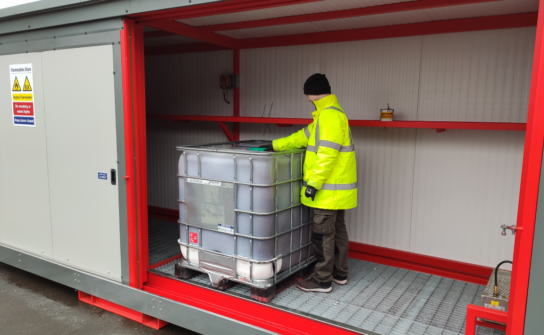
- Ensure compliant storage: Verify that your storage hardware—from flammable cabinets to bunded IBC stores—is fit for the specific hazard class it holds.
- Keep up-to-date digital records: Log maintenance checks, chemical safety training sessions, or spills so your records are accessible whenever an inspector arrives.
The Role of Storage Systems in Audit Readiness
Well-designed storage solutions are the foundation of audit readiness because they reduce reliance on human procedural controls and ensure safety features are ‘built-in’.
At Safety Storage Systems UK, we provide a variety of solutions that can help you meet current regulatory environment. Features such as built-in secondary containment and fire protection ensure that spills and fires are contained at source, reducing reliance on human intervention. Our modular and adaptable chemical storage solutions simplify segregation, ensuring incompatible substances remain strictly separated.
Advanced solutions such as leak detection sensors and automated incident logging further support compliance, not only by reducing risk, but also by providing the digital audit trail that regulators now expect as standard.
Conclusion: Your Trusted Safety Partner
As regulatory scrutiny intensifies, taking a proactive approach to chemical storage is the path of least resistance. By investing in robust storage systems and continuous compliance processes, you can benefit from reduced risk, smoother inspections, and, most importantly, a safer environment for your workers.
At Safety Storage Systems UK, we bring over 20 years of expertise to help you specify the best solutions for your hazardous materials. Whether you are adapting to the new PFAS Plan or preparing for future REACH deadlines, we are here to support your ongoing compliance journey.
Contact our team today to discuss how our modular storage solutions can future-proof your facility against the challenges of 2026 and beyond.